Artificial Intelligence Challenges the Future of Music: Ally or Threat?
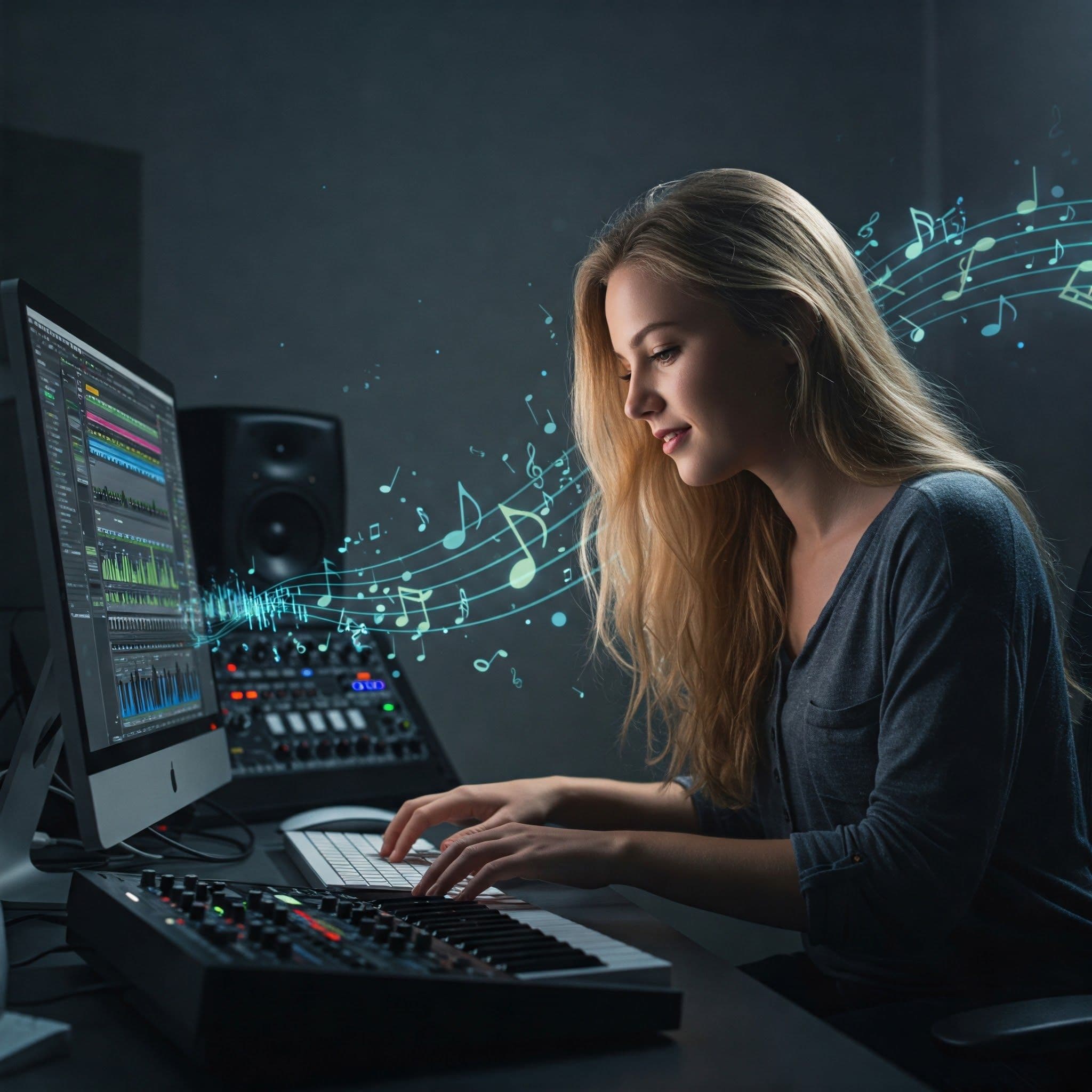
New technologies are revolutionising the composition, production, and distribution of music, creating unprecedented opportunities while challenging traditional models. Sound art is reinventing itself, redefining its boundaries.In the studios of contemporary musicians, a new muse has begun to whisper in binary code. Generative artificial intelligence, a set of algorithms capable of creating original content, is redrawing the contours of human creativity, transforming musical scores into probability matrices.
From song lyrics generated in seconds to musical compositions crafted at the click of a button, AI has entered the music world with unprecedented force. But how is it truly transforming these fields? Is it a threat to artists or a revolutionary tool that expands their creative possibilities?
The Digital DNA of Creativity
Generative AI is not a magic wand that produces art for art’s sake. At its core, these systems operate like dancers who have learned their steps by studying millions of previous works.
AI-powered music generators have consumed entire libraries of compositions. These systems do not memorise; they reimagine. Each new creation is a dance between learned patterns and algorithmic variations, resembling a chef experimenting with familiar ingredients rather than a photocopier replicating images.
Generative AI is no longer merely an auxiliary tool but an active collaborator in artistic production. It functions through neural networks trained on vast amounts of data, learning patterns and styles from millions of musical pieces and texts to generate new content.
But can a machine truly create art, or is it merely recombining pre-existing information? Music, the universal language of emotions, stands at a crossroads where the boundary between human creativity and artificial generation is becoming increasingly blurred.
A Growing Phenomenon
A report by Market.us predicts a radical transformation in the music industry, driven by artificial intelligence.
The study estimates that the global AI music market, currently valued at $3.9 billion, will reach $38.7 billion by 2033, with an annual growth rate of 25.8%.
The data is compelling: 74% of internet users already use AI to discover or share music, and 82% struggle to distinguish between human and algorithm-generated compositions. The technology has reached such a level of sophistication that it can generate a basic melody in under two seconds, increasing human composition speed twentyfold.
Adoption among musicians is significant: 60% already use AI in music creation and production. Streaming platforms like Spotify leverage these capabilities to predict listener preferences with 86% accuracy.
The report suggests that AI will not replace musicians but rather act as a technological collaborator, expanding the boundaries of musical creativity in the digital age.
The Price of Innovation
The rise of AI-generated music has sparked both admiration and concern. Some artists embrace the technology as a means to push creative boundaries, while others perceive it as a threat to human authorship and the sustainability of the cultural industry.
One of the most notable pioneers in this field is Taryn Southern, an American artist who, in 2017, released I AM AI, an album composed entirely with artificial intelligence. Using tools such as Amper Music, Southern explored how technology can serve as an extension of human creativity, enabling her to generate sounds and melodic structures that would otherwise be difficult to conceive.
Another innovator at the intersection of AI and music is Holly Herndon, who has utilised algorithms to transform her voice and create complex soundscapes. Her 2019 album PROTO exemplifies collaboration between humans and machines, incorporating a choir of synthetically generated voices using artificial intelligence. For Herndon, AI is a tool that expands the concept of musical composition.
Daniel Ek, CEO of Spotify, recently stated that artificial intelligence "could be potentially huge for creativity" and "should lead to more music, which is great culturally."
At the same time, the emergence of AI in music has provoked strong resistance from much of the artistic community. In April 2024, over 200 musicians—including Billie Eilish, Katy Perry, Pearl Jam, Juanes, and J Balvin—signed a letter promoted by the Artists Rights Alliance (ARA), denouncing the use of AI to generate musical content without human artists' participation.
The letter calls on digital platforms to refrain from developing or implementing technologies that could replace human creativity, arguing that the unchecked advancement of AI could devalue art and undermine musicians’ rights.
Meanwhile, the International Confederation of Societies of Authors and Composers (CISAC) recently published a report warning of the economic impact generative AI could have on the music and audiovisual industries in the coming years.
The study estimates that by 2028, music creators could lose up to 24% of their income, equating to a €10 billion reduction over the next five years. Conversely, AI providers’ revenue in the music sector could grow from €0.3 billion to €9 billion in the same period.
The report attributes much of this growth to the unauthorised use of copyrighted works to train AI models without fair compensation for creators.
Additionally, it forecasts that by 2028, AI-generated music will account for approximately 20% of streaming platform revenues and up to 60% of music library revenues.
Where Are We Heading?
The debate over AI in music and the arts is far from settled. While some creators view it as a tool that enhances artistic possibilities, others see it as a threat that could displace human artists and devalue their work.
In the coming years, the music industry is likely to witness the rise of hybrid creation models, where AI serves as a catalyst for human creativity rather than a replacement.
The key will be to establish regulatory frameworks that protect artists' rights, ensure fair compensation, and foster technological innovation.
The music of the future may become an ongoing dialogue between human intuition and algorithmic power, where each note emerges from a collaboration between the musician’s sensitivity and the machine’s computational capabilities.